
Who Cares? Why Canada Needs a Public Child Care System
Oxfam Canada, 2019
by Diana Sarosi and Elly Adeland
Excerpt: “Public child care is key to closing the economic gender gap, enabling women to pursue
job opportunities and decent work and to reduce their financial losses due to caring responsibilities. Getting more women to work is essential to growing Canada’s economy, and that growth will ensure investments made in child care will be recovered in tax revenues. Women working in the child care sector deserve good wages and benefits and families should not have to make tough choices between working and caring. We all want our children to grow up in an environment that fosters their well-being and development. It is time for Canada to go the extra mile and make public child care a reality.”
Women, work and COVID-19: Priorities for supporting women and the economy
Canadian Centre for Policy Alternatives, 2021
by Katherine Scott
Excerpt: “COVID-19 has been particularly hard on women in Canada, especially lower-income women experiencing intersecting inequalities based on race, gender identity, class, disability, immigration status, and other social identi- ties. This study focuses on three areas: (1) It examines the impact of COVID-19 on women’s participation in the labour market since the pandemic struck in spring of 2020; (2) It assesses the impact of federal and provincial government programs and income supports through a gendered and intersectional lens; (3) It examines gaps in the system and proposes measures to help women get through the COVID crisis and ensure their speedy return to the labour market once the worst of the crisis is over.”
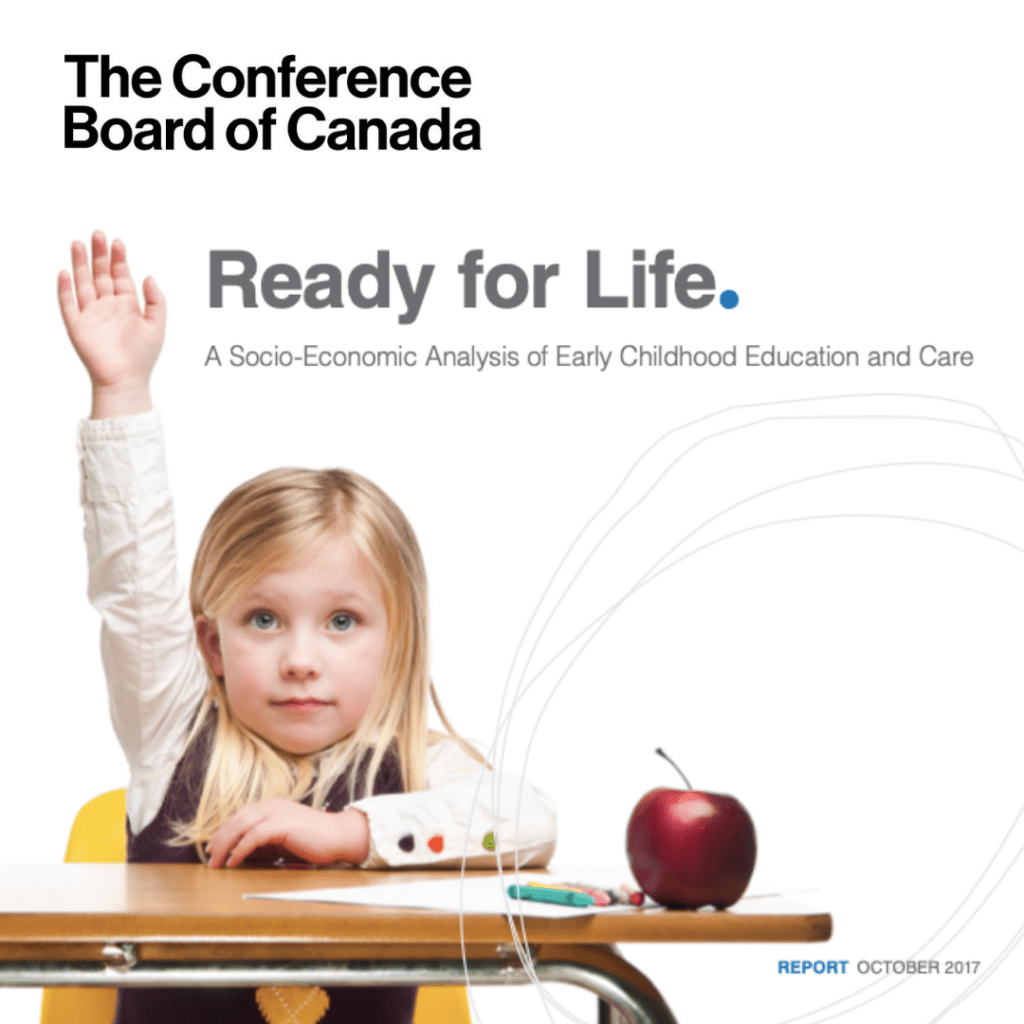
Ready For Life: A Socio-Economic Analysis of Early Childhood Education and Care
Conference Board of Canada, 2017
by Craig Alexander, Kip Beckman, Alicia Macdonald, Cory Renner, and Matthew Stewart
This report examines the role early childhood education (ECE) can have in reducing income inequality and boosting economic growth. Canada’s current provision of ECE is compared with peer countries to highlight the strengths and weaknesses in Canada’s approach. The cost and benefits of ECE investments are evaluated over a long time horizon. The impact of higher ECE on income inequality is also quantified.
A bad bargain for us all: Why the market doesn’t deliver child care that works for Canadian children and families
Childcare Resoruce and Research Unit, 2019
by Martha Friendly
Excerpt: “The idea that the struggle for universal child care in Canada is a “nev- er-ending story” resonates with many who have analyzed it. Political economist and comparative researcher Rianne Mahon, who described
it as a “never-ending story”, observed: “On the one hand, there is a stubborn and persistent need for good-quality child care linked to the high labour force participation of mothers. […] On the other hand, there are barriers that continue to block the development of an accessible, high-quality, publicly funded child care system” (Mahon, 2000: 2). While many of today’s young parents seeking high quality, affordable child care for their own young children are unaware of the issue’s lon- gevity, the picture of Canadian child care has been a dismal one for more than forty years.”
Progressive Pricing: Making Childcare More Affordable in Manitoba
Canadian Centre for Policy Alternatives
by Susan Prentice
Excerpt: “The plain and simple summary of these findings is that affordable childcare is either revenue neutral, or actually generates money, for Manitoba. Manitoba will need to build more childcare spaces to meet the anticipated increased demand, but this is more than do-able. In first five to ten years, the capital expenditures would outstrip returns, but by within a decade, the cost of growth will be covered and Manitoba can reap economic as well as social returns from more affordable childcare.
Manitoba has the ability to do right by children and families, and to grow our provincial economy by moving to a system of progressive pricing and more affordable childcare. This will be a boon to families, and a benefit to the economy.”
 I Care About Child Care